Turning the Stanford AI Index into Action
There is no longer any serious debate about whether AI matters. Stanford’s 2026 AI Index shows that AI has moved from speculation to infrastructure: 88% of organizations now use AI in at least one business function, and AI agents have leapt from experimental prototypes to systems that successfully complete roughly two‑thirds of complex real‑world tasks on OSWorld‑style benchmarks. The inflection is real—but so is the gap between what AI can do and what most organizations are structurally ready to absorb.
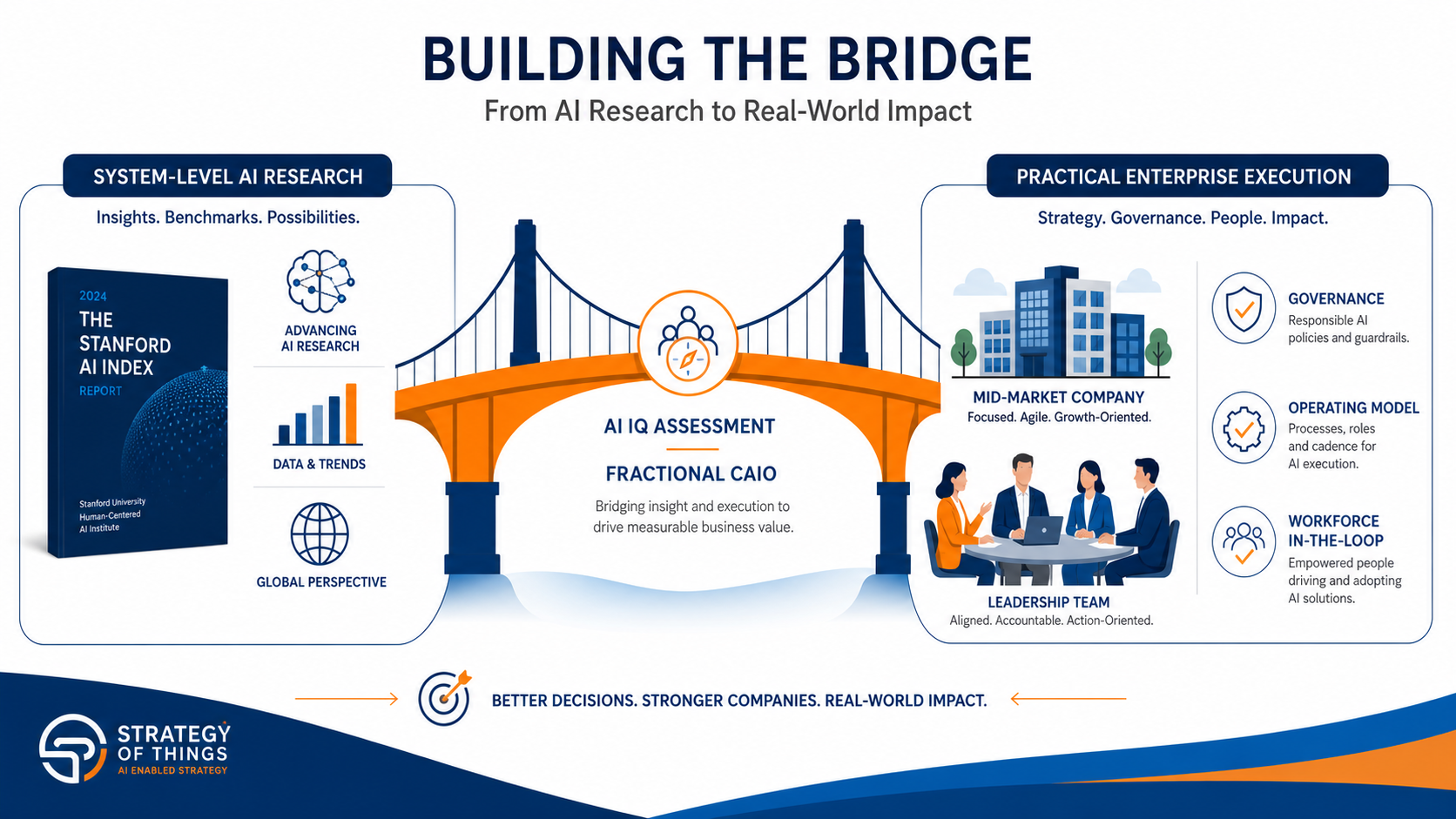
The question is no longer “Can AI work?” It is “Can our operating model, governance, and workforce carry AI at scale without losing control of cost, risk, or trust?” That is exactly the gap our AI IQ assessment is designed to expose and help you close. It is twelve multiple-choice questions and takes five minutes to complete. It is based on our SoT AI Enterprise Reference Model, a nine-layer framework that maps every dimension of AI capability an organization needs to deliver sustained business value.
What the Stanford AI Index is telling boards right now
The 2026 AI Index is unambiguous on three fronts that matter for any leadership team:
-
AI adoption is now mainstream.
Stanford reports that nearly nine in ten organizations are using AI somewhere in the business, and generative AI has reached mass adoption faster than any prior general‑purpose technology. -
Agentic AI is crossing a capability threshold, but not a reliability threshold.
Across benchmarks, AI agents have jumped from low double‑digit success rates to around two‑thirds of tasks completed correctly, which is remarkable progress—but still leaves a meaningful failure rate on real workflows. -
Governance and readiness lag far behind deployment.
Responsible AI roles and policies are rising—organizations with no responsible AI policy dropped from 24% to 11% in a year—yet Stanford’s responsible AI chapter still finds persistent gaps in knowledge, budget, and standardized evaluation. Enterprise commentary around the Index is clear: governance, validation, and readiness remain the primary barriers to scaling AI, not model performance.
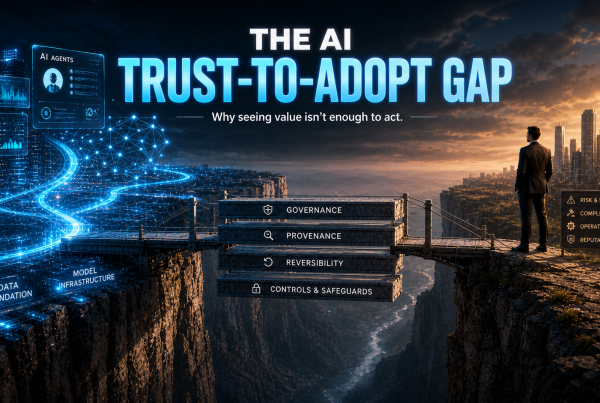
In other words: AI systems and agents are racing ahead. Organizational structures, leadership, and governance are not keeping up.
The missing middle: from system‑level reports to organization‑level readiness
Stanford’s AI Index is invaluable as a system‑level lens on progress in research, industry, and policy. But a board or executive team still needs to answer a more local question:
“Where does our organization actually sit on this curve, and what needs to change in the next 90 days?”
Most companies right now have one of two things:
-
High‑level awareness of reports like Stanford’s AI Index and the NIST AI Risk Management Framework, but no concrete mapping to their own operating reality.
-
Or a scattered collection of AI projects, pilots, and tools—but no objective diagnostic of their foundation, operating model, or human‑zone readiness.
That is the “missing middle link” we built our AI IQ assessment to fill: connecting world‑class system‑level insight to the practical, organization‑level decisions that determine whether AI creates sustained value or plateaus after the pilot stage.
How our current assessment lines up with Stanford’s findings
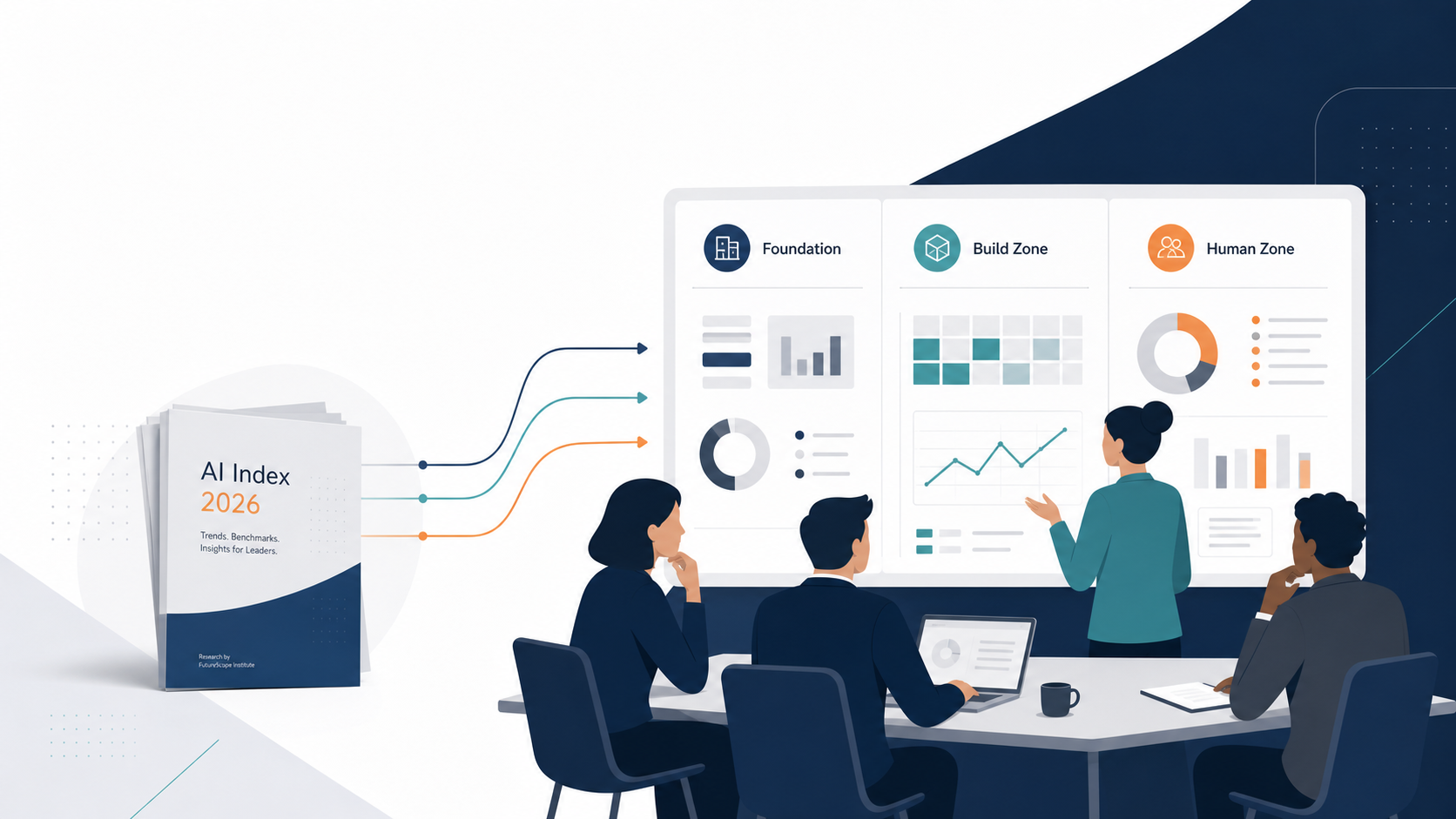
Our AI IQ assessment is intentionally structured around the same themes the AI Index and leading governance frameworks highlight: foundation, build, and human zones.
1.Foundation (infrastructure, data, and security)
Stanford’s economy and responsible AI chapters underscore that productivity gains and risk outcomes depend heavily on data quality, infrastructure reliability, and security—not just model choice.
Our assessment probes the strength of your data foundations, integration patterns, and security posture, surfacing where pilots are running on “borrowed infrastructure” that will not scale.
2. Build zone (from pilots to operating model)
AI Index coverage and derivative analyses emphasize that benchmark performance does not automatically translate into robust enterprise process execution; organizations struggle to move from experimentation to production.
We measure your ability to go beyond isolated pilots: how repeatable your build patterns are, how well you govern agents and workflows, and how clearly your initiatives connect to measurable business outcomes.
3.Human zone (governance, workforce, leadership)
Stanford reports rapid growth in AI‑specific governance roles and policies, but also that gaps in knowledge, budget, and regulatory clarity are still the main obstacles to responsible AI.
Our assessment evaluates your governance structures, decision rights, board engagement, workforce‑in‑the‑loop design, and leadership readiness—because most AI failures today are human and organizational, not technical.
By design, every assessment debrief ties your scores back to the exact challenges Stanford’s AI Index is quantifying at the global level. That link helps boards and executives see that their internal discomfort has external evidence.
From diagnostic to strategic guidance: what participants actually receive
The purpose of the assessment is not to give you another score. It is to give you a structured, defensible plan for the next 90–180 days.
Participants walk away with three things:
-
A clear structural picture of where they stand
We don’t just tell you that your AI program is “ahead” or “behind.” We show how your foundation, build zone, and human zone compare—often revealing the pattern Stanford’s Index hints at: the technology layer is stronger than the operating and governance layers. -
A small set of high‑leverage moves
We identify 3–5 moves that materially change your readiness: governance decisions, operating‑model adjustments, or workforce‑in‑the‑loop patterns that address the exact gaps the AI Index warns are holding organizations back. -
Forward guidance from a fractional CAIO perspective
The assessment is framed as if a Chief AI Officer were sitting across the table, showing you where your program is structurally sound, where the real risk lies, and how to talk about it to your board with clarity instead of hype. That is the same voice we will bring to The CAIO Brief series.
In other words, the assessment takes a global research signal and translates it into an actionable operating plan for your specific context.
Why this matters to Stanford—and why the mid‑tier matters
Stanford HAI’s mission is to advance AI that is human‑centered, safe, and socially beneficial. The AI Index is a flagship contribution to that work, providing policymakers, researchers, and industry with a shared factual baseline. But there is a critical layer between research and policy on one side and individual companies on the other: mid‑tier organizations that make up much of the real economy and are now deploying AI at speed.
This is where Strategy of Things operates.
-
We work in the environments where AI is “just one more thing” on an already full executive agenda—but where risk, workforce trust, and governance are no longer optional.
-
Our assessment instrumentation and forthcoming AI‑to‑Impact Index are designed to capture how AI is actually showing up in these organizations: not as benchmarks, but as operating decisions, governance choices, and workforce outcomes.
That data has value not only for the organizations we serve, but also for the broader research community. A grounded, longitudinal view of mid‑market AI readiness and workforce‑in‑the‑loop patterns would be a natural complement to the system‑level perspective of the AI Index.
With guidance from advisors who understand both worlds, including Stanford‑affiliated experts in governance and AI policy, we are deliberately building our assessment and operating architecture to be compatible with frameworks like the NIST AI Risk Management Framework and aligned with the themes the AI Index tracks.
What comes next: The CAIO Brief and the AI‑to‑Impact Index
This interim post is the bridge to two things:
-
The CAIO Brief
A ten‑week series written from the vantage point of a fractional Chief AI Officer, translating findings from the AI Index, NIST frameworks, and our own assessment data into sharp, board‑ready narratives for mid‑market leaders. -
The AI‑to‑Impact Index
A longitudinal, anonymized view of how real organizations progress from AI activity to AI impact across the foundation, build, and human zones, informed by every AI IQ assessment and aligned conceptually with Stanford’s AI Index categories.
If the AI Index answers “Where is AI headed in the world?”, our work aims to answer “What does it take for organizations like yours to get there responsibly, and what patterns actually work in practice?”
For leaders who want to move from AI hype to operating reality, the next step is straightforward: start with an honest diagnostic, grounded in the same themes Stanford is measuring—then use it to guide the structural changes that your technology, your workforce, and your board actually need.