The CAIO Led Strategy for Canada:
Canada is making a consequential shift in AI policy: it is no longer treating compute as a background technical input, but as national economic infrastructure. The Canadian Sovereign AI Compute Strategy is explicitly designed to expand domestic compute capacity, support the Canadian AI ecosystem, safeguard Canadian data and intellectual property, and drive economic growth through made-in-Canada AI solutions.
That shift creates a new executive mandate. The next era of AI leadership in Canada will not be defined only by who experiments fastest with models, but by who can govern data, compute, decisions, and workforce transformation in a way that is sovereign, trusted, and commercially scalable. This is where the role of the Chief AI Officer, or CAIO, starts to matter in a fundamentally different way.
Why the CAIO role is changing
For the last two years, many organizations treated AI as a collection of pilots, tools, and proofs of concept. That approach is no longer enough. As public and commercial investment accelerates around sovereign AI infrastructure, the harder question becomes operational: how should Canadian institutions actually run AI across critical workflows, sensitive data, distributed operations, and changing workforce models?
A modern CAIO is not just responsible for model selection or vendor strategy. The role now sits at the intersection of business transformation, data governance, edge operations, risk management, workforce design, and national competitiveness. In practical terms, the CAIO becomes the executive accountable for translating sovereign AI capacity into measurable outcomes: productivity, resilience, secure innovation, workforce amplification, and long-term institutional control.
The CAIO is not an HR configuration
It is tempting to treat the CAIO as a new executive job description or a talent-market label. That framing is too small for what Canada now needs. The CAIO is not simply an HR configuration; it is a multi-dimensional operating role responsible for how humans, agents, knowledge systems, and edge environments work together at scale.
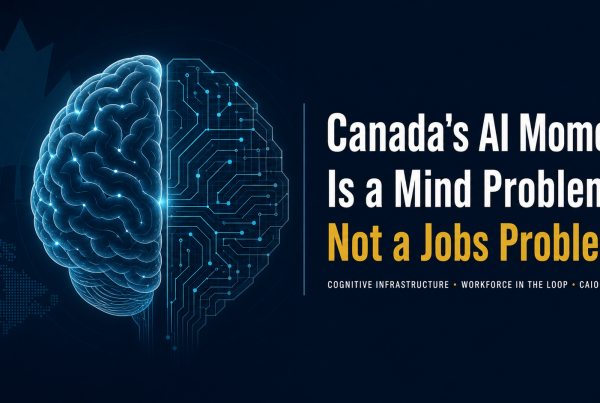
This matters because the workforce challenge is no longer linear. Organizations are not just deciding which jobs to automate. They are redesigning work across non-linear dimensions: human judgment, agent autonomy, cross-functional coordination, institutional memory, operational safety, and productivity under real-world constraints. At that level of complexity, only AI itself can help coordinate the emerging workforce at scale.
Workforce in the Loop, then Workforce of the Future
The next step beyond human-in-the-loop is Workforce in the Loop. That means moving from isolated human approvals to a full operating model where people, AI systems, and decision processes are intentionally designed to work together. In this model, the workforce is not an afterthought or a mitigation layer. It is part of the architecture.
That shift also changes how Canada should think about talent. An AI superpower will not be built only through infrastructure spending or by accumulating raw technical talent. Those matter, but they are not enough on their own. The deeper opportunity is to build an AI superpower by design: creating institutions and industries where work is structured from the start for human-AI coordination, sovereign control, and continuous adaptation.
The CAIO is the executive who makes that design visible and operational. The role defines where agents can act, where humans must decide, how accountability is preserved, and how organizations evolve from today’s workforce into the workforce of the future without losing trust, productivity, or sovereignty.
Why sovereignty matters in practice
Canada’s sovereign AI push is grounded in a simple idea: if the country wants to remain globally competitive, it cannot rely indefinitely on foreign compute for the most important layers of its AI future. The federal strategy states directly that reliance on foreign computing resources creates risks around security of access, privacy, and the sovereignty of Canadian data.
But sovereignty is bigger than where servers sit. In operational terms, sovereignty also means knowing where sensitive data moves, which models are making decisions, what logs and evidence exist, how workforce authority is assigned, and who can intervene when an AI system is uncertain or wrong. For sectors such as health care, energy, manufacturing, and public services, that means designing AI systems that are accountable across the full chain from data to action, not just compliant at the infrastructure layer.
Why edge compute belongs in the strategy
The sovereign AI conversation often starts with supercomputing and large-scale data centres, for good reason. The federal strategy includes support for both private-sector AI data-centre projects and major public supercomputing infrastructure, reflecting the need for domestic capacity at national scale.
But Canadian advantage will also depend on what happens closer to the edge. In health systems, industrial operations, utilities, transportation, and civic infrastructure, value is created where data is generated and acted on in near real time.canada Edge-oriented AI architectures can reduce latency, improve resilience, support local control of sensitive information, and make it easier to align AI decisions with operational realities on the ground.
That makes the CAIO’s job broader than cloud procurement. The role increasingly includes designing when AI should run centrally, when it should run at the edge, how those environments stay governed together, and how workforce accountability is preserved across both.
From infrastructure to operating capability
Canada is investing in the foundations of sovereign AI. The next challenge is to convert that infrastructure into a repeatable operating capability that organizations can actually deploy. That requires more than compute access alone.
It requires a deployment model with six characteristics:
-
Sovereign data control, so sensitive information and intellectual property remain within Canadian legal and institutional boundaries.
-
Governed AI operations, so organizations can monitor models, log decisions, manage lifecycle changes, and intervene safely when conditions shift.
-
Edge-ready architectures, so industries with distributed assets and real-world operational constraints can use AI where it creates value fastest.
-
Workforce-in-the-Loop design, so AI, people, and institutional processes are coordinated as one operating system rather than as separate layers.
-
Human-accountable workflows, so AI augments judgment in critical environments instead of obscuring it.
-
Configurable deployment capacity, so organizations can stand up fit-for-purpose AI fabrics quickly rather than spending years and millions on one-off builds.
This is the real strategic opening for Canada. The institutions that win will not be the ones that simply buy AI tools. They will be the ones that design a governed operating layer on top of sovereign compute and edge capacity, then use it to scale adoption safely across the enterprise, across sectors, and across the future workforce itself.
The sectors where this matters first
The federal government has already framed sovereign AI infrastructure as a foundation for progress in health care, energy, advanced manufacturing, and scientific discovery. Those same sectors are the most likely to benefit from a CAIO mandate tied to operating capability and workforce design rather than experimentation alone.
In health care, a sovereignty-first CAIO can align clinical, administrative, and research AI around data residency, auditability, trustworthy decision support, and workforce redesign that protects care quality while improving capacity. In energy and critical infrastructure, the priority is resilient AI at the operational edge, where safety, explainability, workforce authority, and continuity matter more than generic automation. In manufacturing, the opportunity is to combine sovereign industrial data, edge intelligence, and workforce productivity into a more competitive production system designed for continuous human-AI coordination.
A new definition of future-proofing
Future-proofing is often used as a slogan, but in this context it has a concrete meaning. It means building AI systems that can adapt as policy evolves, as domestic compute capacity grows, as edge environments become more intelligent, as workforce models shift, and as expectations around trust and accountability become stricter.
For Canada, this is not only about reducing risk. It is about expanding national economic possibility. If sovereign compute becomes the digital backbone and edge AI becomes the operational frontier, the CAIO becomes the executive who connects those investments to real-world advantage: stronger institutions, more productive industries, protected intellectual property, a better-designed workforce, and a more durable innovation economy.
What leaders should do now
Canadian boards, deputy ministers, CEOs, and operating executives should treat the CAIO role as a strategic operating function, not a symbolic title. The priority is to define how sovereign data, compute, governance, workforce design, and edge execution come together inside the organization before AI adoption outruns institutional control.
The organizations that move first will shape the playbook for the rest of the country. They will show that sovereign AI is not only a matter of national policy, but a practical path to economic advancement, institutional resilience, and the next generation of Canadian competitiveness built by design.