From Pilots to Production: Building Canada’s Human-Centred AI Fabric
A VectoredValue perspective on sovereign AI strategy, workforce governance, and the institutions Canada must build now.
Canada is at an inflection point. The question is no longer whether artificial intelligence will transform the economy — it already is. The question is whether Canada can move fast enough, and wisely enough, to govern that transformation on its own terms.
Two urgent conversations are converging. One is about national AI architecture: how Canada turns research excellence into deployable, governed capability at scale. The other is about the workforce: how institutions, employers, and communities navigate a transition that is reshaping not just jobs, but the very nature of work. These are not separate conversations. They are two dimensions of the same strategic challenge.
The Architecture Problem: From Research Stars to a National Fabric
Canada has world-class AI research talent. What it has lacked is the connective tissue — the layers that transform that talent into sovereign, deployable capability across government and industry.
Those layers are not optional. They are cumulative:
-
Without research intelligence, you are blind — unable to see which occupations are being automated, which communities are most exposed, and where intervention is most urgent.
-
Without capability engines, you are slow — unable to translate research into production-ready models that ministries and agencies can actually deploy.
-
Without fabrics, you are constrained — trapped in pilots that never scale, in bespoke systems that cannot interoperate.
-
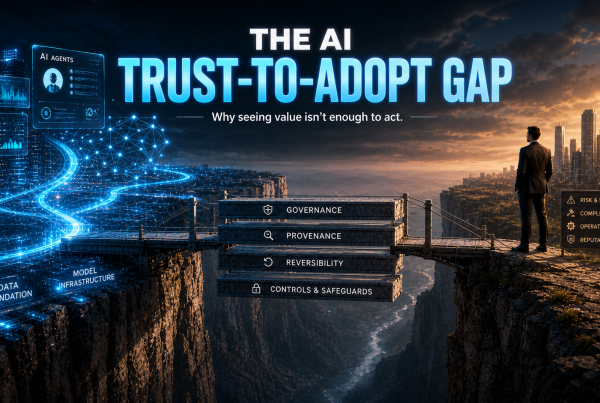
Without governance doctrine, you are exposed — deploying AI without the accountability frameworks that protect workers, citizens, and institutions.
-
Without a CAIO Council, you cannot align economics, risk, and public value — the three forces that must be held in productive tension for AI to serve the country rather than disrupt it.
PM Carney’s campaign and early policy signals have put AI at the heart of a broader economic transformation: reskilling workers, modernizing public services, and investing heavily in digital infrastructure and adoption incentives. That agenda is explicitly human-centred. It treats AI as a way to raise human productivity, institutional quality, and long-term value creation — not to replace people at scale.
To realize that vision, the Pan-Canadian AI Strategy must do three things:
-
Treat the national AI institutes as foundations of a fabric, not as isolated research stars. CIFAR, Vector, Mila, and Amii are national assets — but only if they are wired together into a coherent capability architecture.
-
Move from “more compute” to governed, values-aligned fabrics that ministries, agencies, and OEMs can deploy in roughly 90 days with clear risk and impact cases.
-
Stand up a CAIO Council as a Service, backed by NIST-aligned frameworks and rigorous economic modeling, to keep humans above and on the loop as AI fabrics spread through the economy.
In that world, new data centres and partnerships are not the strategy — they are the substrate. The real strategy is how Canada orchestrates research, governance, infrastructure, and ingenuity into a single, human-centred AI Fabric of Things.
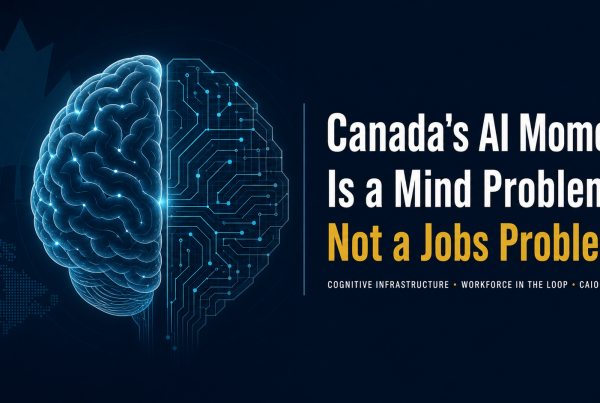
The Workforce Problem: Task Loss, Role Redesign, and the Entry Ramp Crisis
The AI jobs conversation is entering a new phase.
The Economist‘s recent warning about an “AI jobs apocalypse” reflects a growing anxiety — especially among graduates and knowledge workers watching entry-level pathways narrow. But the reality is more complex than simple job loss. In Canada, Statistics Canada data shows employment still growing across AI-exposed roles, even as vacancies and entry-level opportunities — particularly in coding-heavy fields — begin to contract.
This is not just about jobs disappearing. It is about something more structural:
-
Task loss — as AI absorbs discrete, repeatable cognitive work within roles
-
Role redesign — as the remaining work shifts toward judgment, relationship, and oversight
-
Fewer entry ramps — as junior pathways narrow before new ones have been built
-
Skills volatility — as the half-life of technical credentials continues to shrink
-
Trust — as workers, communities, and citizens ask whether this transition is being governed in their interests
Canada’s Future Skills Centre estimates that 57.4% of jobs are highly exposed to AI, including public administration itself. The OECD has emphasized that AI can improve both productivity and job quality — but only if risks around automation, bias, privacy, transparency, and loss of agency are actively governed. The potential is real. So is the risk of getting it wrong.
The Response: CAIO as a Service and the Workforce in the Loop Design Lab
Knowing the risks is not the same as governing them. That is exactly why VectoredValue has built its CAIO as a Service offering, anchored by the Workforce in the Loop Design Lab.
Organizations do not just need AI strategies. They need embedded capacity to continuously govern AI in practice. The CAIO as a Service model provides that ongoing leadership layer. The Design Lab is the operating environment where workforce impacts are tested, measured, and redesigned in real time.
Governments need more than policy statements. They need live intelligence: which occupations are AI-competing, which are AI-augmenting, which communities are most exposed, and where workforce pathways must be rebuilt. That intelligence must flow into decisions — not sit in reports.
Employers need more than productivity tools. They need defensible governance models that clearly define where human judgment, worker voice, oversight, and accountability remain essential. In a regulatory environment that is moving fast, “we deployed AI responsibly” must be demonstrable — not asserted.
Through the Design Lab, organizations can make AI adoption visible, measurable, accountable, and human-centred. It creates a practical way to answer the questions that matter:
-
Which work should be automated?
-
Which work should be augmented?
-
Which workers need transition support?
-
Which decisions require human oversight?
-
Which skills should be built now?
-
Which risks must be governed before deployment?
The Thread That Must Hold
There is a concept worth naming here: a literacy of continuity.
It is the shared ability of people, communities, and institutions to understand how identities, relationships, and systems hold together across time — and to design choices today that protect that thread into the future.
Canada’s AI transition will test this literacy. The pressures are real: economic disruption, institutional inertia, geopolitical competition, and the accelerating pace of the technology itself. What holds the thread is not resistance to AI, and it is not blind acceleration. It is the institutional capacity to steer.
That is what CAIO as a Service enables.
That is what the Workforce in the Loop Design Lab operationalizes.
And that is where the real work begins.
The future of work will not be secured by resisting AI or blindly accelerating it. It will be secured by building the governance architecture — the fabric — that keeps human judgment, human value, and human voice at the centre of the transition.
VectoredValue exists to help make that fabric real.