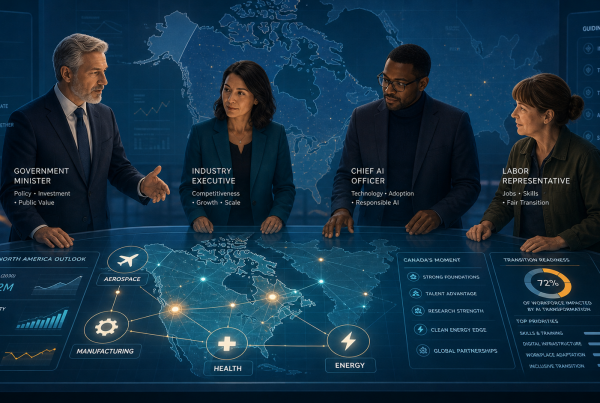
Canada now has sovereign AI data centres, an AI Minister, and a renewed Pan‑Canadian AI Strategy — but compute alone will not deliver the human‑centric, economy‑wide transformation Prime Minister Mark Carney is talking about.
What’s missing is an architecture that turns research excellence and infrastructure into orchestrated, values‑aligned outcomes at scale.
From Research Institutes to a Pan‑Canadian Fabric
Canada’s national AI institutes — in Edmonton, Montréal, Toronto and their emerging peers — already anchor a world‑class research and talent ecosystem. They are central to the Pan‑Canadian AI Strategy’s goals: more researchers, stronger collaboration, and global thought leadership on the economic and ethical implications of AI.
But the next phase is different in kind, not just in scale. It must connect these institutes to ministries, Crown corporations, OEMs, and regional ecosystems through an integrated research‑to‑fabric‑to‑outcomes stack, rather than hoping that more models and more compute will somehow self‑organize into national advantage.
The Limits of a Compute‑First Strategy
The federal government is moving quickly to secure sovereign AI infrastructure, with large‑scale data centre proposals, MOUs, and funds backing dozens of projects. Those investments are necessary: without domestic compute, Canada will simply rent its future from others.
However, a compute‑first strategy has three systemic gaps:
-
It does not by itself define what should be built — which fabrics, in which sectors, under what constraints.
-
It does not orchestrate who and what is brought to each problem — capabilities, SMEs, partners, and IP.
-
It does not ensure that AI deployment advances the human‑centric values and broad‑based prosperity that Carney has made central to his economic vision.
Bridging those gaps requires more than infrastructure. It requires a Pan‑Canadian AI operating model.
The Emerging Operating Model: Five Layers
Across Canada and comparable jurisdictions, we can already see the outlines of that operating model.
-
Research‑intelligence and knowledge routing. AI research institutes and their partners maintain living maps of global science, standards, and risks, surfacing “empty shelves” — areas where new work would have the highest marginal impact.
-
Capability and early‑stage IP engines. Ecosystems track real capabilities (teams, SMEs, reusable components, patterns) across ministries, agencies, OEMs, and startups so X‑teams and SME mirrors can form around opportunities in days, not months.
-
Sovereign AI fabrics and orchestration infrastructure. Sovereign and sectoral AI fabrics run multi‑agent workloads across cloud, edge, and device while meeting Canadian requirements for performance, privacy, and residency.
-
Governance, risk, and compliance doctrine. A Continuum‑style, multi‑chapter doctrine defines guardrails for classifier architectures, data use, telemetry, human‑on‑the‑loop controls, and sovereign design, producing board‑level artefacts and a 90‑day, deployment‑ready “fabric lab” at a fraction of bespoke engineering costs.
-
CAIO Council as a Service. A Pan‑Canadian Chief AI Officer Council — operating as a service to governments, agencies, and OEMs — uses NIST‑aligned resilience research, economic modeling tools, and ecosystem value‑creation frameworks (such as Strategy of Things’ work) to align AI deployment with fiscal reality, labour markets, and public values.
VectoredValue sits at the intersection of these layers, acting as an integrator of research, governance doctrine, infrastructure, and economic modeling so that AI investments compound into durable national advantage rather than a patchwork of pilots.
A Governance‑Centric Architecture Table
In a governance‑first framing, the Alberta Plan’s components and the emerging enterprise stack line up roughly as follows:
-
Amii- Perception / state representation → Research‑intelligence and knowledge routing: turning research, standards, and signals into structured knowledge graphs.
-
Needed: Options and subtasks → Capability and early‑stage IP engines: discovering reusable patterns; assembling X‑teams and SME mirrors around opportunities.
-
Needed: Transition model and planning → AI fabrics and orchestration infrastructure: enabling multi‑agent planning, routing, and execution across the compute continuum.
-
Needed: Reward shaping and constraints → Continuum‑style governance doctrine and controls: defining what “good” looks like and how risk is measured and governed at scale.
-
Needed: Intelligence amplification → CAIO Council as a Service: setting strategy, aligning economics, and ensuring humans remain above and on the loop.
-
Ecosystem‑level value creation → vectoredvalue.com and innovation partners: connecting ministries, agencies, OEMs, and customers into shared value‑creation loops.
For Canada, the important point is that all of these layers are necessary to move from pilots to production fabrics: without research intelligence, you are blind; without capability engines, you are slow; without fabrics, you are constrained; without governance doctrine, you are exposed; and without a CAIO Council, you cannot align economics, risk, and public value.
Human‑Centric Value in Carney’s Vision
PM Carney’s campaign and early policy signals have put AI at the heart of a broader economic transformation: reskilling workers, modernizing public services, and investing heavily in digital infrastructure and adoption incentives. That agenda is explicitly human‑centric; it treats AI as a way to raise human productivity, institutional quality, and long‑term value creation, not to replace people at scale.
To realize that vision, the Pan‑Canadian AI Strategy must do three things:
-
Treat the national AI institutes as foundations of a fabric, not as isolated research stars.
-
Move from “more compute” to governed, values‑aligned fabrics that ministries, agencies, and OEMs can deploy in roughly 90 days with clear risk and impact cases.
-
Stand up a CAIO Council as a Service, backed by NIST‑aligned frameworks and rigorous economic modeling, to keep humans above and on the loop as AI fabrics spread through the economy.
In that world, new data centres and partnerships are not the strategy — they are the substrate. The real strategy is how Canada orchestrates research, governance, infrastructure, and ingenuity into a single, human‑centred AI fabric of things, and VectoredValue exists to help make that fabric real.
A literacy of continuity is the shared ability of people, communities, and institutions to understand how identities, relationships, and systems hold together across time – and to design choices today that protect that thread into the future.