Closing the Trust-to-Adopt Gap: How Strategy of Things and Continuum Build the Trust AI Adoption Requires
Executive Summary
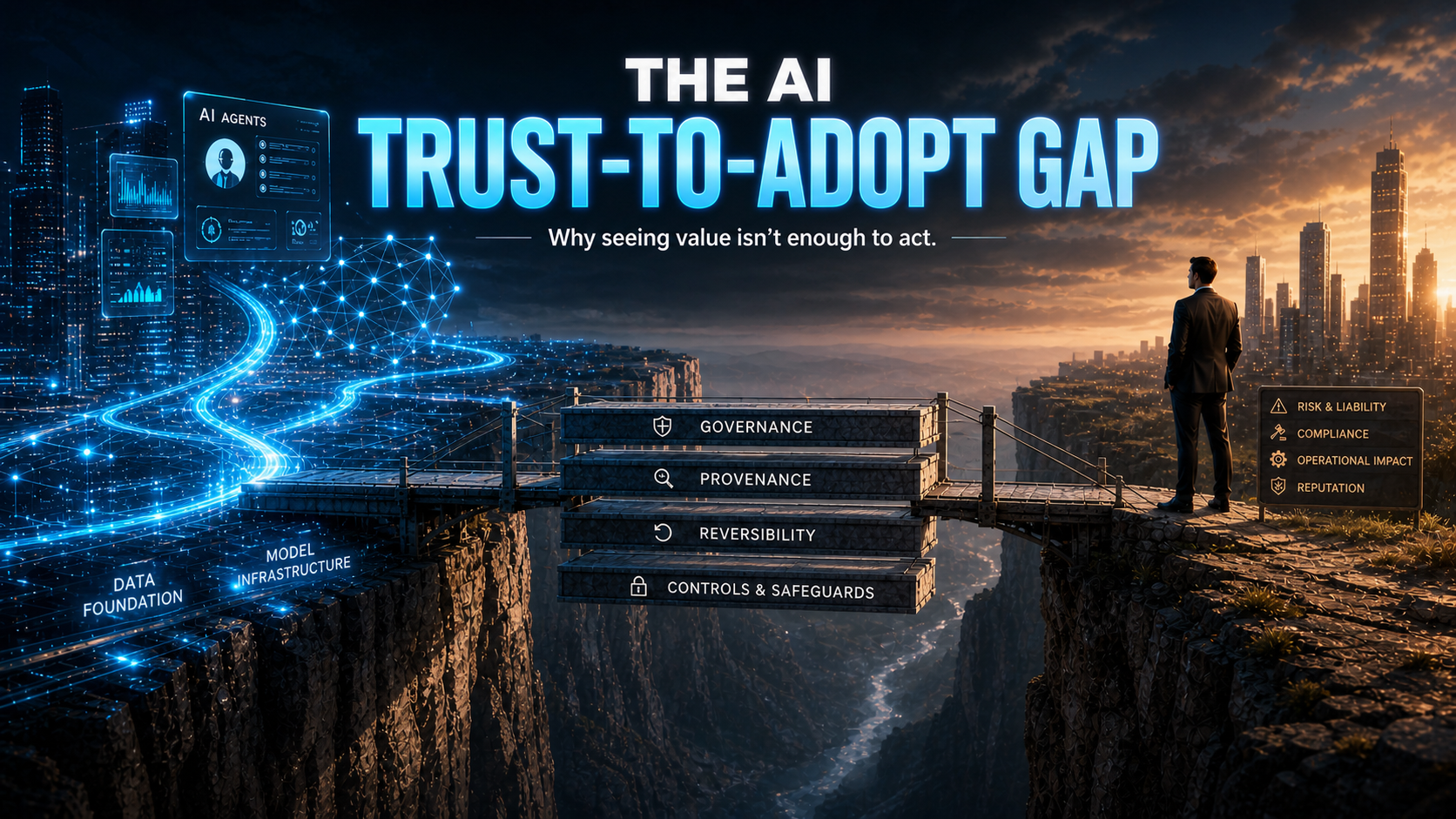
Andrew Maxwell’s The Trust-to-Adopt Gap white paper makes a foundational claim that resonates deeply with the Continuum doctrine: users do not adopt because they see value — they adopt when they trust enough to take the next step. This is not an abstract observation. It is the operating reality facing every enterprise, government agency, and critical-infrastructure operator we engage with. The paper’s five core ideas — trust as threshold, adoption as sequence, prototypes as trust experiments, trust gap closures, and trust directionality — map with striking precision onto what the Continuum Series and Strategy of Things services were designed to do architecturally, not just conceptually.
This response argues that the Continuum is not merely an AI safety framework. It is, in Maxwell’s precise terms, a trust manufacturing system — an architecture that systematically raises trust thresholds, reduces the required trust threshold for each next adoption behaviour, and makes the direction of trust explicitly measurable and governable. Strategy of Things is the prime coordination agency that operationalizes this architecture inside client organizations, walking them from interest to action across every stage Maxwell describes, with the Continuum as the sovereign-grade governance infrastructure behind every commitment made.
The Fear Vector IS the Trust Gap
Maxwell identifies the “strongest competitor to innovation” as doing nothing — familiar, defensible, risk-free inaction. The Continuum business doctrine names the same phenomenon with greater precision: the Human Fear Vector.
“When AI is 10× faster, humans feel augmented. When AI is 40× faster, humans feel dependent. When AI is 400× faster, humans feel replaced.”
This is not irrational resistance. The Continuum explicitly frames it as the correct response to systems that operate outside human review cycles. Maxwell would recognize this as the adoption-risk dimension of trust — users refusing to act because trying the innovation might create unacceptable downside. In Continuum terms, that downside is cognitive displacement: the point at which agent velocity exceeds human narrative authority.
What both frameworks converge on is this: Fear is a demand signal, not a blocker. Maxwell calls it a trust gap to be closed. The Continuum calls it “the demand signal for safety, governance, and sovereign control.” The diagnosis is the same. The Continuum’s response — classifier-governed cognition, drift envelopes, provenance anchors, reversible autonomy, human-in-the-loop design — is, point for point, an engineering answer to each trust dimension Maxwell identifies.
Mapping Maxwell’s Trust Dimensions to Continuum Architecture
Maxwell identifies fifteen trust dimensions across four categories: trust in the solution, trust in the data, trust in the people/organization, and trust in the adoption context. The Continuum Series architecturally addresses all fifteen. The table below shows the direct correspondence:
| Maxwell Trust Dimension | User’s Core Question | Continuum Architectural Response |
|---|---|---|
| Capability Trust | Can this work? | Classifier-governed agent capability tiers (Levels 0–10), validated benchmark performance |
| Reliability Trust | Will it work repeatedly? | Drift envelope monitoring, continuous anomaly detection, Continuum X telemetry fabric |
| Predictability Trust | Do I understand what it will do? | Mirror Model agents that reflect human intent vectors, not generate autonomous goals |
| Accuracy Trust | Can I rely on the output? | Provenance-anchored decision logs, multi-lens cognitive oversight (microscope/periscope/telescope) |
| Data Trust | Is the data good enough? | Provenance Integrity Office architecture, data lineage tracking, classifier-governed data access |
| Evidence Trust | Why should I believe this claim? | Continuum Series I–XIII as sovereign-grade doctrine corpus; ISO/IEC 30131 standards authorship |
| Transparency Trust | What is hidden from me? | Glass-box over black-box design mandate; BLUF communication culture; chain-of-custody for decisions |
| Competence Trust | Can this team deliver? | Continuum Engineering methodology; CAIO Trajectory playbooks; VIII.2 Safety Manufacturing doctrine |
| Integrity Trust | Are they being honest? | Honest disclosure of drift events, classifier limitations, and uncertainty escalation as mandatory agent duties |
| Benevolence Trust | Are my interests protected? | Humans retain Narrative Authority — absolute, non-delegable; agents reflect intent, never override it |
| Support Trust | Will help be available? | Strategy of Things engagement model: onboarding, governance office setup, renewal cycles |
| Privacy/Security Trust | Is my data protected? | Sovereign enclaves, classified compute, data minimization, zero-trust architecture |
| Accountability Trust | Who is responsible if it fails? | Full audit trails, escalation paths, Cognitive Courts, human override channels — always on |
| Implementation Trust | Can adoption be managed? | Phased pilot-to-production Continuum deployment; workforce integration model (HITL → AITL → Paired) |
| Adoption-Risk Trust | Can I try this safely? | Reversible autonomy by design; safety gates 0–5; limited-scope pilots with exit options |
This is not a coincidence of terminology. The Continuum was built from the same first principles Maxwell articulates — that different trust dimensions matter at different adoption stages, and that governance architecture must be designed to address each one.
Adoption as a Sequence of Trust Thresholds
Maxwell’s second core idea is that “adoption is a sequence of trust thresholds — users may trust enough to listen, but not enough to share data; enough to test, but not enough to rely; enough to pilot, but not enough to change normal work.” This is precisely the logic underlying the Continuum’s Level 0–10 token-economy maturity model.
The Continuum does not ask enterprises to trust a Level 9 sovereign-safe agent on day one. The progression is deliberate:
-
Levels 0–3: Reflexive tool/user agents. Low trust threshold required. Equivalent to Maxwell’s “listen to the idea” and “test a prototype” stages. Retail marketplace dynamics, minimal regulatory overhead.
-
Levels 4–6: Planner and self-modeling agents. Moderate trust threshold. Equivalent to “run a pilot” and “rely on recommendation.” Enterprise exchange dynamics — regulated, audited, drift-monitored.
-
Levels 7–9: Reflective institutional and sovereign-safe agents. High trust threshold. Equivalent to “change workflow” and “accept accountability.” Sovereign clearinghouse dynamics — export-controlled, treaty-governed, provenance-anchored.
-
Level 10: Planetary-grade meta-agents. Equivalent to Maxwell’s “scaling adoption” — requires maximum trust, organizational and political commitment.
Each level transition is, in Maxwell’s language, a prototype-to-trust mapping: it tests not only whether the agent works, but whether the user trusts enough to take the next consequential step. The Continuum’s Safety Gates (0–5) explicitly govern this progression — an agent cannot autonomously escalate its capability tier without crossing a verifiable trust threshold.
Prototypes as Trust Experiments: The Continuum Engagement Model
Maxwell argues that “a prototype should not only ask, ‘Does the solution work?’ It should also ask: Does this experience increase the user’s willingness to take the next trusting behaviour?” This is the operating philosophy of Strategy of Things as a go-to-market and engagement model.
The Continuum Series itself embodies this principle. Each volume is not merely a technical document — it is a trust experiment at scale, structured to move organizations from awareness to adoption through progressive disclosure of evidence, transparency, and demonstrated competence:
-
Continuum I–III: Concept-level engagement. Build capability trust and evidence trust. “Is this worth discussing?”
-
Continuum IV–V: Structured governance frameworks. Build reliability trust and implementation trust. “Can we actually deploy this?”
-
Continuum VI–VII: Sovereign-grade architecture. Build privacy/security trust and accountability trust. “Can government and critical infrastructure rely on this?”
-
Continuum VIII–VIII.2: Safety manufacturing doctrine. Build competence trust and process trust. “Can this team actually deliver at our scale?”
-
Continuum IX–XI: Cognitive infrastructure and long-horizon safety. Build adoption-risk trust and scalability trust. “Can we commit publicly and organizationally?”
This is precisely the prototype-to-trust progression Maxwell maps: sketch → low-fidelity → functional → field → pilot → implementation → scale. The Continuum series walks clients through every stage, generating technical learning and trust learning simultaneously.
Closing the Trust Gap: Five Continuum Mechanisms
Maxwell identifies five strategies for closing trust gaps: raise trust through evidence; raise trust through transparency; raise trust through relationship behaviours; borrow trust from trusted intermediaries; and lower the required trust threshold. The Continuum and Strategy of Things deploy all five — deliberately and in sequence.
1. Raising Trust Through Evidence
The Continuum’s approach to evidence is not assertion — it is sovereign-grade proof. The qdCloud Mirror Agent Classifier Engine provides real-time behavioral classification and provenance-anchored decision logs. The Sovereign Audit Platform delivers regulator-ready evidence bundles and attestation-grade certificates. This is the difference between saying “our agents are safe” (assertion) and producing a complete chain-of-custody for every agent decision (evidence). Maxwell notes that evidence only builds trust “if users find it credible.” ISO/IEC 30131 standards authorship and the SC39 Mirror Committee role are the credibility anchors — not internal claims, but authoritative, independently verifiable standards positions.
2. Raising Trust Through Transparency
The Continuum’s architectural commitment to glass-box over black-box design is absolute. The Continuum III doctrine mandates BLUF (Bottom Line Up Front) communication as a governance mechanism — not just a communication style. “BLUF structures foster a culture of transparent decision-making, ensuring that agentic systems and their human architects align on intent as well as action.” The three-lens oversight model (microscope for agent-level forensics, periscope for real-time anomaly detection, telescope for portfolio-level risk) gives clients the ability to understand, at every scale, exactly what their agents are doing and why. Maxwell’s “transparency trust” — confidence that nothing is hidden — is built through architecture, not assurance.
3. Raising Trust Through Relationship Behaviours
The Continuum’s position on the human-AI relationship is unambiguous: Humans remain the authors of meaning. This is not a marketing statement — it is a classifier-enforced constraint. Agents are constitutionally prohibited from distorting, overriding, or reinterpreting human narrative authority. In Maxwell’s framework, benevolence trust (“Is this being done for me, with me, or to me?”) is the deepest form of relational trust. The Continuum answers it at the architectural level: agents reflect human intent vectors. They cannot self-expand their mission. They must escalate uncertainty. They preserve human meaning as a non-delegable duty.
4. Borrowing Trust From Trusted Intermediaries
Maxwell identifies certification bodies, professional associations, and standards organizations as trust intermediaries that reduce uncertainty enough for users to take the next step. The Continuum operates at the apex of this hierarchy. As the editorial author of ISO/IEC 30131 and National Coordinator for SC39 Mirror Committee Canada, the Continuum doctrine carries the highest available form of standards-level trust capital in AI governance. No competitor can replicate this position — it is not advisory proximity, it is authorship. When an enterprise or government engages with Strategy of Things, they are not borrowing credibility from a vendor; they are engaging the source from which the standards themselves are drawn.
5. Lowering the Required Trust Threshold
Maxwell calls this “the most overlooked strategy” — redesigning the next step so less trust is required, rather than always trying to persuade users to trust more. The Continuum’s reversible autonomy by design principle is the architectural embodiment of this insight. Safety Gates 0–5 ensure that every autonomy increase is reversible. The Human-in-the-Loop model applies for regulated industries and high-risk domains — agents cannot act without human approval. The phased pilot model, the parallel-operation option, and the limited-scope proof-of-value engagement all lower the trust threshold for the next step, making it safe to begin without requiring organizational commitment to the full deployment.
Trust Has Direction: The Continuum’s Dynamic Trust Architecture
Maxwell’s most underappreciated insight is that trust is not static — every interaction builds, damages, violates, or repairs it. The Continuum operationalizes this as continuous drift monitoring — the real-time observation of whether agents are behaving in alignment with the trust that has been extended to them.
Drift events in the Continuum are the technical equivalent of Maxwell’s “trust-damaging behaviours”: missed commitments, inconsistent outputs, ignored concerns. Classifier failures are equivalent to trust violations — serious breaches that change how users interpret system integrity. The Continuum’s mandatory Cognitive Incident Reporting (CIR) protocol — requiring disclosure of drift events, classifier failures, and provenance corruption — is the architectural implementation of Maxwell’s “trust-repairing behaviours”: acknowledge, explain, accept responsibility, correct, prevent recurrence.
Critically, the Continuum does not treat trust as something that can be achieved once and maintained through inaction. The agent renewal cycle — the non-linear depreciation curve where agents gain value through capability upgrades and stabilize through drift correction — is a trust renewal mechanism. Each renewal cycle is a trust-direction signal: the organization is demonstrating that it monitors, corrects, and improves its agents. This is what Maxwell means when he says “a failed prototype can build trust if the team is honest, learns quickly, and improves the design.” The Continuum turns that principle into a governed, auditable, repeatable process.
Appropriate Reliance: The Shared Goal
Maxwell’s most important formulation for AI-specific trust is appropriate reliance — not maximum trust, not minimum trust, but calibrated confidence in what the system can and cannot do, when human judgment is required, and who is accountable.
The Continuum’s token-economy maturity model is a mechanism for appropriate reliance. A Level 3 agent is not asked to carry Level 9 accountability. A Level 7 agent operates under sovereign-safe constraints that explicitly bound what it can do and where it must escalate. The three-tier labor market model — human labor for judgment and meaning, agent labor for cognition and execution, hybrid co-cognitive units for paired operation — is the workforce architecture of appropriate reliance.
Continuum III frames this as the “reflective-reflexive human-AI relationship” — not static delegation, but dynamic co-evolution where both agents and humans calibrate trust based on observed performance, feedback, and continuous learning. This is precisely what Maxwell calls for: users who “understand what the innovation can do, what it cannot do, when it should be relied upon, and what risks remain.”
The Strategy of Things Engagement as a Trust Ladder
Mapping the Strategy of Things client engagement to Maxwell’s diagnostic sequence makes the value proposition explicit:
| Maxwell Step | Maxwell Question | Strategy of Things Activity |
|---|---|---|
| Identify next adoption behaviour | What are we asking the user to do next? | Continuum I–III awareness engagement; BLUF-structured executive briefings |
| Identify consequence of failure | What could go wrong from their perspective? | Fear Vector analysis; 40×–400× capability transition risk assessment |
| Identify relevant trust dimensions | Which dimensions matter most? | Trust Dimension Diagnostic mapped to client’s AI maturity level and domain |
| Assess current trust | What evidence suggests current trust? | Agent capability audit; drift profile assessment; provenance gap analysis |
| Identify the trust gap | Which dimensions are below threshold? | Classifier gap analysis; sovereignty readiness assessment; governance debt review |
| Select intervention | Match intervention to trust gap | Safety Gate deployment; pilot design; Sovereign Audit platform configuration; HITL workflow redesign |
Strategy of Things does not sell a product. It walks organizations through a trust ladder — exactly as Maxwell prescribes — ensuring that each step is appropriately scoped, evidence-backed, reversible, and supported. The Continuum series is the evidence library. The governance architecture is the trust mechanism. The engagement model is the trust ladder.
A Direct Response to Dr. Maxwell
The Trust-to-Adopt Gap framework is intellectually precise and practically important. It correctly identifies that the gap between interest and action is not a communication problem or a feature problem — it is a trust architecture problem.
Strategy of Things exists precisely to close that gap. As the prime coordination agency in AI adoption engagements, Strategy of Things operates as the trust architect — the firm that walks organizations across every threshold Maxwell describes, sequencing the right evidence, the right relationship behaviours, and the right adoption pathway design at every stage. The Continuum Series is the sovereign-grade governance doctrine that makes each step on that ladder structurally credible.
This distinction matters. Maxwell is clear that trust cannot be claimed — it must be designed into the adoption pathway. Strategy of Things is the engagement layer that does exactly that: diagnosing which trust dimensions are below threshold for a given client, sequencing the right Continuum-powered mechanisms to close each gap, and lowering the required trust threshold for the next step rather than simply asserting the solution’s value. The Continuum’s classifier-governed architecture, reversible autonomy, provenance chains, and human-narrative-authority guarantees are the structural components that make those promises auditable, not just credible.
Consider how this plays out across the ladder:
-
At the awareness stage, Strategy of Things facilitates Fear Vector analysis and executive briefings — translating the 40×–400× capability transition risk into language that connects organizational anxiety to actionable governance design. The Continuum Series I–III provides the evidentiary foundation that builds capability trust and evidence trust without demanding organizational commitment.
-
At the pilot stage, Strategy of Things designs limited-scope, reversible engagements — exactly Maxwell’s “lower the required trust threshold” strategy. qdCloud’s Safety Gates 0–5, Human-in-the-Loop model, and phased autonomy progression ensure that every pilot is structurally safe to begin and safe to exit.
-
At the implementation stage, Strategy of Things establishes the governance office, workflow redesign, and co-cognitive workforce model — building the accountability trust, implementation trust, and support trust that Maxwell identifies as the highest-consequence dimensions. The Continuum’s drift monitoring and Cognitive Incident Reporting turn ongoing trust maintenance from an intention into a governed process.
-
At the scaling stage, Strategy of Things provides the organizational and political coordination that Maxwell identifies as the hardest trust threshold to cross — the point where decision-makers must “recommend, defend, and sustain” the solution publicly. The Continuum’s ISO/IEC 30131 standards authorship and sovereign-grade provenance architecture are the borrowed credibility that makes that public commitment defensible.
What Strategy of Things brings that no technology vendor can replicate is trust-ladder coordination: the ability to hold the full adoption sequence, manage the relationship behaviours that Maxwell identifies as critical when evidence is still incomplete, and match each intervention precisely to the trust gap in front of the client — not the trust gap the vendor wishes existed. The Continuum is the architecture that makes those interventions structurally sound. Strategy of Things is the agency that makes them land.
Maxwell’s framework ultimately asks: who is responsible for designing the trust conditions that allow adoption to occur? The answer is not the technology itself. The answer is the engagement partner who understands that adoption is a sequence of trust-based behaviours, that each behaviour requires a different trust threshold, and that closing the gap requires both raising confidence and reducing the cost of the next step. That is the Strategy of Things mandate — with the Continuum as the sovereign-grade infrastructure behind every commitment made.
Prepared in response to “The Trust-to-Adopt Gap” (Dr. Andrew Maxwell, Innovation Doctor, June 3, 2026) in the context of Strategy of Things and Continuum services positioning.
The assessment is the first decision. Everything that follows gets easier once you have it. Find out where your program stands
The CAIO Brief is published by Strategy of Things. Each issue delivers strategic AI intelligence for industrial and mid-market executives navigating AI investment, organizational readiness, and the decisions that determine whether AI creates sustained business value.