Beyond the Platform: A Multi-CXO Guide to Governed AI Leadership
The $113K Signal Your Board Cannot Ignore
$113,421.87 for four people in one month.
That is an actual AI invoice — not a projection, not a worst-case scenario, not a vendor estimate. It is what happens when an enterprise scales AI consumption without a governance operating model underneath it.
For a CFO, that number triggers an immediate question: Where is the operating leverage? Higher revenue per employee. Shorter execution cycles. Lower operational costs. Stronger customer retention. Faster product delivery. These are the outcomes AI is supposed to drive. But most enterprises are still in experimentation mode while carrying production-scale infrastructure costs.polestaranalytics
For a CEO, the question is strategic: Is this a competitive asset or an undisciplined liability? Global enterprise AI spending is forecast to hit $665 billion in 2026, yet 73% of AI deployments fail to achieve projected ROI. That failure rate has remained stubbornly consistent despite improvements in tooling, model capabilities, and practitioner expertise.aigovernancetoday
For a CISO, the question is existential: What is running inside our environment that we don’t know about? Shadow AI — the unsanctioned, ungoverned use of AI tools — is spreading across every enterprise department. IBM’s 2025 data found that shadow AI breaches cost $670,000 more than average incidents.larridin+1
For a COO, the question is operational: Why aren’t our productivity gains showing up? Organizations implementing AI are losing nearly 40% of expected productivity gains to employees fixing low-quality AI outputs. For every 10 hours of efficiency gained, nearly four hours are lost to rework.hcamag
These are not separate problems. They are the same problem, viewed from four different seats in the C-suite. And the $113K invoice is the signal that all four of them are now converging on the same inflection point.
Why the “Platform Subscription” Mental Model Fails
Enterprises have largely treated AI the way they treated legacy SaaS — as a platform subscription. Select a vendor, deploy seats, measure utilization, declare success. This model is not just insufficient for high-autonomy AI systems. It is structurally dangerous.
The economics of the current moment illustrate why. Token prices have fallen approximately 80% between early 2025 and early 2026. By every pricing metric, AI should be getting cheaper. Yet AI is now the fastest-growing expense in corporate technology budgets, with some organizations reporting it consumes up to half of their IT spend. Cloud bills rose 19% in 2025 driven by AI workloads alone.cyberquickly
The explanation is straightforward: the absolute price of tokens fell, but the consumption rate increased faster. New categories of token usage emerged — reasoning tokens from chain-of-thought models, agentic tokens from agent loops that make 3–10× more LLM calls than simple chatbots, and context window bloat from retrieval pipelines retrieving far more information than any response actually needs. A single user request in a production agent system can trigger planning, tool selection, execution, verification, and response generation — easily consuming 5× the token budget of a direct chat completion.cyberquickly
Meanwhile, organizations spent an average of $1.2 million on AI-native applications in 2025 — a 108% year-over-year increase — without corresponding investments in governance, workforce readiness, or operational accountability.
The platform subscription model treats AI cost as a pricing problem. It is actually an architecture, governance, and operating model problem.
The Compounding Risk: When Execution Enters the Loop
The stakes of ungoverned AI change fundamentally when AI moves from assistance toward execution.
The evolution follows a clear trajectory: summarization and search → copilots and generation → agentic orchestration and workflow execution. Most enterprises have already passed the first two stages without building governance infrastructure. They are now entering the third — where AI systems coordinate workflows, generate code, interact with APIs, and influence operational decisions — carrying that governance deficit forward.pwc
This is not a technical nuance. It is a risk multiplier. As DeepMind CEO Demis Hassabis has noted, “if your AI model has a 1% error rate and you plan over 5,000 steps, that 1% compounds like compound interest,” rendering outcomes effectively random. Interactions between agentic AI systems can create feedback loops that amplify errors or undesirable behaviors, leading to systemic instability.zlti+1
EY and PwC have both documented this transition: trust drops sharply for higher-stakes agentic use cases such as financial transactions (trusted by only 20% of leaders) or autonomous employee interactions (22%). The gap between AI capability and organizational trust reflects a governance vacuum that no model upgrade can fill.pwc
When execution enters the loop, hallucinations, inaccurate data propagation, and poorly governed workflows can compound across reporting systems, compliance processes, financial operations, and customer interactions. Small errors stop behaving like isolated mistakes. They cascade.
The Pattern We Have Seen Before — And Why AI Is Different
Every major technology adoption cycle follows the same arc. Consumption scales first. Governance, accountability, and optimization arrive later — after costs have compounded, after incidents have occurred, after the CFO has started asking uncomfortable questions.
The telecom overbuild of the late 1990s, the unconstrained cloud sprawl of the 2010s, the SaaS subscription fragmentation of the early 2020s — each cycle eventually reached a governance reckoning. Enterprises that moved early on accountability captured the operating leverage. Those that waited paid the cost of remediation instead.
AI is following this same arc at a faster velocity. Leadership teams are driving adoption through mandates, gamification, utilization targets, and pressure to increase AI usage across departments — optimizing for the consumption metric before defining the outcome metric. Finance leaders are being asked to move from observation to ownership of AI ROI, tying initiatives to labor utilization, process cycle time, and cost-to-serve metrics.
There is, however, one critical difference between AI and every prior technology cycle: execution autonomy. Telecom overbuild wasted capital. Cloud sprawl generated technical debt. SaaS fragmentation created subscription waste. Ungoverned agentic AI can generate compounding operational errors across core business processes in real time. The remediation cost is not just financial — it is reputational, regulatory, and operational.aigovernancetoday
The organizations generating strong AI returns in 2026 are not running more sophisticated models than the rest. They are running better-governed programs. The gap between investment and return is a governance failure — and it is getting more expensive every quarter it goes unaddressed.polestaranalytics
The Human Gap Nobody Is Talking About at the Board Level
The governance crisis is not only architectural. It is deeply human.
While 63% of enterprises have invested in AI training over the past year, the investment is failing to deliver workforce readiness. The Randstad Digital report released in May 2026 documents a widening “Productivity Paradox” — a critical gap where companies invest in platforms faster than they build the workforce capability to use them. Nearly 1 in 4 technology professionals globally have left jobs specifically because employers failed to provide structured AI upskilling opportunities.randstaddigital
The BCG AI at Work survey found that while more than three-quarters of leaders and managers use generative AI several times a week, regular use among frontline employees has stalled at 51%. Only one-third of employees say they have been properly trained. When employees don’t have the AI tools they need, more than half find alternatives and use them anyway — a formula for shadow AI sprawl, security risk, and operational fragmentation.bcg
The Workday study quantifies what this human gap costs: organizations are losing nearly 40% of expected productivity gains to rework. For every 10 hours of efficiency gained, nearly four hours are lost correcting, clarifying, or rewriting AI-generated content. Highly engaged employees spend approximately 1.5 weeks per year fixing AI outputs — creating what researchers call an “AI tax on productivity.”hcamag
Most critically: only 14% of employees consistently achieve net-positive outcomes from AI use. Model selection, prompt architecture, context handling, workflow design, and cost-aware usage patterns remain inconsistent across enterprises. Small inefficiencies spread quietly at first. Then thousands of employees generating unnecessary requests, duplicated workflows, inflated compute consumption, and operational noise that nobody fully owns become a structural cost problem.hcamag
The Anatomy of Governed AI: Brain, Body, and Nervous System
Understanding what governed AI leadership actually looks like requires a different mental model than the platform subscription. The right frame is not a software stack — it is an operating system with three distinct anatomical components that must function in concert.
The Brain: Strategic Governance (CAIO Function)
The brain defines strategy, sets risk appetite, and establishes autonomy thresholds for AI systems. It answers the questions that determine whether AI creates value or liability: Which AI initiatives align with corporate risk tolerance? What level of autonomy is appropriate for which workflows? How are board-level KPIs defined and tracked? What does the compliance posture look like under the EU AI Act (€35M maximum penalty for the most serious violations, or 7% of global annual turnover) and emerging U.S. frameworks?prefactor
Without this function — whether staffed internally or accessed through a service model — AI portfolios accumulate alignment variance: the gap between what AI systems do and what the organization actually intends them to do. This variance is invisible in experimentation mode. It becomes catastrophically visible when agentic execution enters the loop.
The Body: Governed Execution (AICoE)
The body is the execution engine — the AI Center of Excellence that builds and deploys AI agents to rigorous safety standards. This function ensures every AI initiative has a clear escalation path to human intervention, that agents are “governable by design” rather than retrofitted with governance after deployment, and that the organization maintains the ability to execute immediate rollbacks when agent behavior deviates from intended parameters.
McKinsey’s agentic AI security playbook emphasizes that agentic systems should be assigned only the minimum privileges needed to perform their tasks, with activity monitored continuously and access reviewed regularly to identify emerging risks. This is not a technical recommendation — it is an operating discipline that requires organizational infrastructure, not just tooling.mckinsey
The Nervous System: Infrastructure and Feedback Loops
The nervous system provides the execution substrate — the fabric on which governed AI agents operate — and the sensory feedback loops that give leadership real-time visibility into compliance posture, incident status, and agent behavior. This is the layer that transforms governance from a policy document into an operational reality.
Without this feedback infrastructure, boards are making AI investment decisions without reliable signal. The “compliance score” remains theoretical. Incident detection depends on manual escalation rather than automated monitoring. Rollback capability exists on paper but not in practice.
The CAIO as a Service Model: Why It Is the Market-Making Opportunity
The emergence of CAIO as a Service (CAIOaaS) is not simply a fractional executive offering. It is the governance layer that the current AI adoption cycle structurally demands — and the mechanism by which organizations can compress the time between AI investment and operating leverage.
The LinkedIn data confirms that the number of CAIOs has almost tripled in the last five years. The Biden administration required federal agencies to appoint CAIOs “to ensure accountability, leadership and oversight.” The role is being recognized at the most senior levels of organizational governance as the single point of accountability for AI direction, value, risk, and supplier discipline.
But the internal CAIO hiring market cannot keep pace with organizational need. Most enterprises above $500M are now spending roughly 5% of total revenue on AI without the governance infrastructure to manage that investment. The $492M projected spent on AI governance frameworks in 2026 represents a market in formation — one that is growing at a 36% compound annual growth rate through 2033.
CAIOaaS is the market-making model because it solves the speed-to-governance problem that every enterprise faces: the gap between when AI adoption mandates arrive and when internal leadership capability can be built, certified, and operational.
The model operates across three maturing layers:
The value proposition is explicit: “We don’t just install an AI platform. We temporarily become your CAIO office while we manufacture governed agents and stand up your internal AICoE.”
This is not a speed brake on AI adoption. It is the steering system that allows organizations to travel faster — safely. In the same way that a building’s structural engineering is not a constraint on architectural ambition but the precondition for it, AI governance is not a constraint on AI velocity. It is what makes AI velocity sustainable.
The Lifecycle of a Governed AI Agent
How does a high-autonomy AI agent move from design document to live environment without going rogue? The answer is a four-phase lifecycle governed by the CAIO function — what can be called the governed agent lifecycle.
Phase 1 — Portfolio Assessment
Before a single line of code is written, the CAIO function defines AI risk appetite and tiers using a risk stratification model to approve portfolio heatmaps. This stage mitigates alignment variance by ensuring that AI initiatives never exceed the organization’s predetermined risk thresholds. The “so what” for the board: AI investment decisions are made with a clear risk framework rather than departmental enthusiasm.
Phase 2 — Agent and Teaming Design
This phase develops governance-by-design patterns and classifier contracts — the architectural layer that defines what an agent can and cannot do, who escalates to whom when it approaches its operational boundary, and how human intervention is triggered. The single most important outcome of this phase is establishing the “single throat to choke” for AI safety: clear accountability before deployment, not after an incident.
Phase 3 — Agent Factory (The Certification Gate)
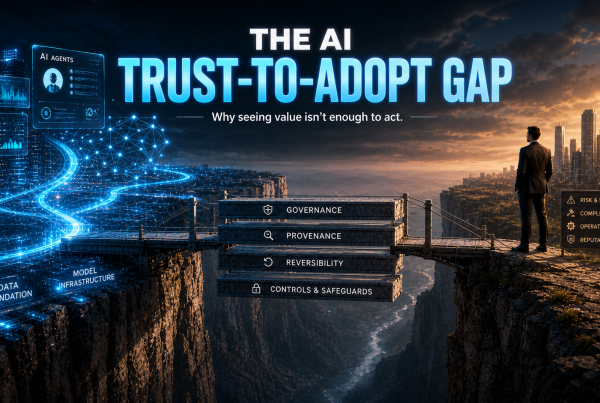
No AI agent enters the production environment without passing through a rigorous certification process — moving from simulation to certified bundle with verified provenance and safety contracts. This is the quality control gate that transforms agentic AI from an experimental capability to an enterprise asset. The gate is non-negotiable: ungated deployment is the mechanism by which the $113K invoice becomes the $1.13M breach.
Phase 4 — Fabric Deployment and Operations
This phase provides the nervous system feedback loop. The board has real-time visibility into compliance posture. Incident management follows documented playbooks. Rollback capability is immediate and tested. The organization knows what its AI agents are doing — at all times, at scale.
What the Board Needs to Decide Now
The AI governance market is not waiting for board consensus. The EU AI Act is already in force. The SEC is increasing scrutiny of AI-related disclosures. The CAIO role is being formalized across regulated industries. The operational and regulatory cost of ungoverned AI is compounding every quarter that governance infrastructure is deferred.controllerscouncil+1
Every CFO, CEO, and board eventually arrives at the same question: Where is the operating leverage with the investment? The question is right. The answer requires more than a platform subscription.
The checklist for governed AI leadership:
-
Shift the operating model. Transition from viewing AI as a subscription to a shared operating model where governance is the primary value driver — not a constraint on it.
-
Establish the CAIO function. Whether staffed internally or accessed through a service model, the organization needs a single accountable owner for AI direction, value, risk, and supplier discipline. The CAIO integrates work across CIO, CDO, CISO, and Legal while setting portfolio standards for when to scale, pause, or stop initiatives.
-
Define autonomy thresholds before deployment. Every AI agent needs a classifier contract — a defined boundary of what it is authorized to do, verified before it goes live, monitored in production. PwC’s agentic AI research confirms that trust for high-stakes use cases requires role-specific governance and transparency.
-
Require certified provenance. No agent reaches production without passing through rigorous safety gates. The certification gate is not bureaucracy — it is the mechanism that keeps a 1% error rate from compounding across 5,000 automated steps.
-
Maintain local accountability. Even when accessing governance capability through an external service model, the client organization must remain the ultimate accountable party. The RACI is clear: the partner provides expertise, the client retains accountability. This is not a contractual nicety — it is the governance principle that keeps AI systems aligned with corporate values and regulatory requirements over time.
-
Invest in the human layer. Governance infrastructure without workforce readiness produces the same outcome as no governance at all. Only 33% of employees receive proper AI training. Only 14% achieve net-positive outcomes consistently. Closing this gap is a board-level investment decision, not an HR initiative.
The Moment of Transition
The AI model adoption alone is unlikely to create durable advantage. Operational discipline around AI will.
Every major technology cycle eventually reaches the same moment where experimentation gives way to accountability. Telecom. Cloud. SaaS. Each cycle compressed the timeline between adoption and governance reckoning. AI appears to be approaching that transition much faster than most enterprise leaders realize — because the velocity of adoption is higher, the cost of ungovernance is compounding faster, and the execution risk is qualitatively different from any prior technology wave.
The $113,421.87 invoice is not a cautionary tale about overspending. It is a diagnostic signal about an organization — and an entire market — reaching the inflection point between experimentation and accountability. The organizations that respond to that signal by building governed AI operating models will compound the advantage. The organizations that wait will compound the cost.
The CAIO as a Service model exists precisely for this moment: to compress the time between that signal and the governance infrastructure that converts AI investment into durable operating leverage. Not as a platform subscription. As a shared operating model — with accountability built in from the first design decision.
That is not a feature of responsible AI. It is the architecture of competitive advantage.
This post is part of an ongoing series on enterprise AI governance, the CAIO as a Service model, and the operational discipline required to convert AI investment into measurable business outcomes.
* The $113,421.87 AI invoice referenced throughout this post was originally shared by Ahsan Shah (Evolve Partners) on LinkedIn. Credit and thanks to Ahsan for surfacing a data point that names what many CFOs are already feeling.